Wednesday, April 28, 2010

Bird dialects

While I was in Atlanta, I read a New York Times story about birding apps for iPhones and the like. (Until I get another job, I can't afford an iPhone but I'm lusting after one.) The article says that developing an app that identifies birdsong is problematic because birds have regional "dialects."

That was a coincidence because I'd been listening to the breeding song of the cardinals in Atlanta and it was noticeably different from those in Miami, 700 miles to the south. The song in Miami has a higher pitch and is faster.

Has anyone else noticed the same thing with cardinals or other birds?

Friday, April 23, 2010

Visiting my mother-in-law in Atlanta ...

My MIL lives in Buckhead, which, if you know Atlanta, is an area of grand homes and splendid gardens.

I've missed the dogwoods, but the azaleas are at their best, and I'm told that it's the "best best" for years.

My MIL is elderly, frail, and has a list of ailments as long as your arm. Each weekday is about trips to this clinic followed by appointments with that doctor. It's no vacation.

Whenever I can, I escape to the garden and its magnificent oaks, magnolias and tulip maples. I look up at these towering trees, breathe in their spirit and feel my own blood pressure sink. To paraphrase the King James version of Psalm 121, "I lift up mine eyes to the trees ..." The sun is warm and the flowers are glorious. It only takes a few minutes to feel restored.

Friday, April 16, 2010

Amazon lily

Sorry about the poor photo, I was experimenting and forgot to take better ones.

Anyway, for the first time my Amazon lily (Eucharis grandiflora), which I keep in a clay pot, has flowered. I've had the plant for years and always kept it in shade, per most horticultural recommendations. Then, I read somewhere that they like sun, so I moved it into a sunny pot, and Hey Presto, it flowered! Go figure!

Tuesday, April 13, 2010

Return of the swallow- tailed kites

I saw the first swallow-tailed kite of the year, today. (Click on the link if you're not familiar with them.) I reckon they are the most beautiful birds of prey on the planet. Once seen, not forgotten.

They're such graceful, acrobatic fliers, too, rarely flapping their wings as they wheel around in tight circles, controlling their flight by simply twisting their tails.

Prior to Hurricanes Katrina and Wilma, which, in 2005, took out so many of our trees and birds' nesting places, I would see as many as two dozen circling overhead. I'm not sure where they nest now, but I haven't seen those numbers since.

Until a few years ago, nobody was sure where they spent the winter. Eventually, they were tracked to the Brazilian/Paraguayan border, a journey of some 4,000 miles.

(The photo is from the U.S. Fish and Wildlife Service and is in the public domain.)

Monday, April 12, 2010

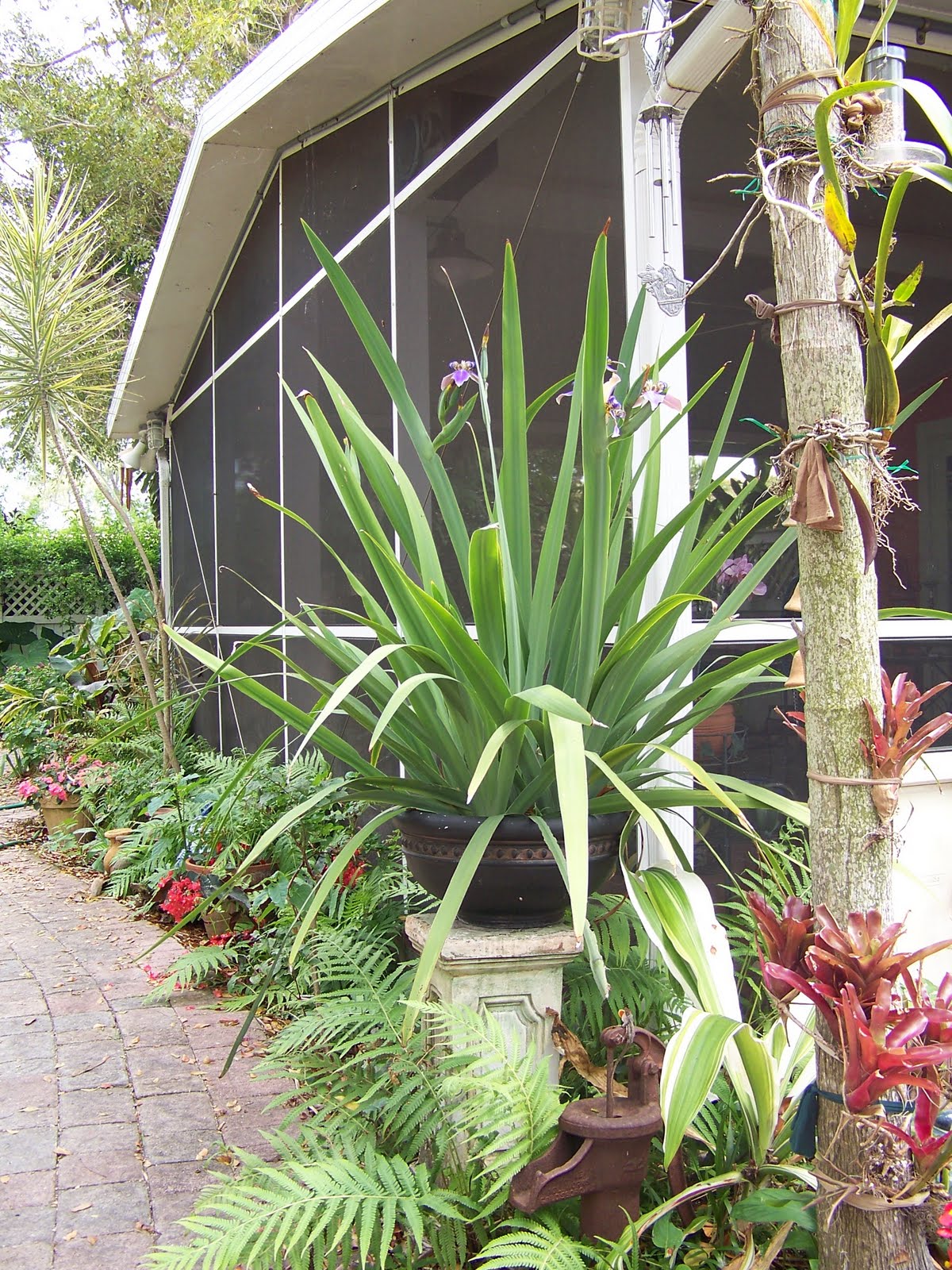
Blue walking iris


My pots of Neomarica caerulea 'Regina' are beginning to bloom. These bigger versions of the blue walking iris are spectacular in a large pot raised off the ground allowing the bloom-bearing leaves to arch over.

Wednesday, April 7, 2010

Stemmadinia littoralis: An ideal tree for a small, tropical garden

"Lechoso" is a small tree, native to Central America, that's gaining well-deserved popularity; Fairchild Garden made it the 2009 Tree of the Year. It has an open habit and produces delightfully perfumed white flowers throughout the warmer months. Ideally, it should be planted near open windows, outside seating, or somewhere you can benefit from the scent.

I planted mine a few years ago and it's about 12' tall, now. The literature says it will reach about 20'. It's shaded from the strong afternoon sun by an oak. Apparently, it's happier with the shade, but other than that, it doesn't require any maintenance, being quite happy to do its own thing.

Another benefit is that it didn't seem to suffer much from the freeze, despite getting the full force of the northwesterly wind. It dropped some leaves, but it's blooming again now. That makes me think it might work in Zone 9 in a sheltered spot.


Monday, April 5, 2010

Karma and gardening

Once a week I go to a Tibetan Buddhist dharma center to work in the garden. Considering its location, just a few miles north of downtown Miami, it's a surprisingly big garden. At the moment, I'm the only person volunteering there, so until others get the gardening bug, things only just stay tamed.

I was there last Thursday. It was one of those days that make us remember why we live in South Florida: warm and sunny with the slightest chill on the breeze. I found a shady chair at the end of the garden, which has become totally wild, and gave myself up to the day. Butterflies, damsel flies, bees, citrus blossom, wild flowers. Even the city noise dimmed. And all the while, a mockingbird sang his heart out above me.

Buddhists say that experiencing moments like this is the karmic consequence of previous positive actions. Upon recognizing that, one immediately pays forward such "merit," asking that all sentient beings may, in turn, experience such peace.

Saturday, April 3, 2010

Erythrina: Eye candy for a spring day


I came across this Erythrina in Coral Gables. After shedding its leaves it produced these stunning blooms.Glorious!

Friday, April 2, 2010

Growing nasturtiums with the GROW Project, March report

One of the many reasons nasturtiums are on my top-five list of annuals is for the saucer-like shape of the leaves; in a mixed planting, they set off other foliage beautifully.

As you can see from the first photo, the Spitfire seedlings are doing nicely. I think everything I planted germinated, but, my bad, I'm such a sloppy record-keeper... I've got about 25 seeds in various locations, in containers as well as the ground, where they can trail or climb. One location will suffer from more neglect than others, so that will be a test. Traditionally, the more they are neglected, the more they bloom.

With a bit of luck, I'll get the first flowers by late April.

I'm hoping that Spitfire will hold its blooms above the foliage. One fault in older varieties of these otherwise splendid plants is that you have to hunt for the (edible) flowers. The second photo shows a trailing nasturtium snaking along but its lovely yellow blossoms tend to stay out of sight.

Tuesday, March 30, 2010

Mystery solved! Plant ID revealed

It's Vicia acutifolia, a native vetch. I learned this from Suzanne Koptur, a biology professor at Florida International University. According to Dr. Koptur, it can be found in "many Florida counties."

The vetch continues to grow but it's being attacked by blackflies, which I'll need to deal with. It's got lots of tiny pods (click on the photo), so I'm sure it will seed itself again.

If anyone wants seeds, let me know.

Monday, March 22, 2010

Is your veggie garden ugly?

Well, my veggie patch wouldn't win any beauty pageant; the tomatoes have all fallen over in their useless tripod cages and weeds abound, but hey, it's still a lot of fun.

GardenRant.com had a guest post about ugly -- or neglected -- vegetable gardens that has set off quite a buzz in the garden-blogging world. Add your thoughts at the above link.

Sunday, March 21, 2010

Plant ID, anyone?

This tiny -- and very pretty -- little vetch appeared in a pot. Can anyone tell me what it is? Is it a wildflower? Is it a cultivar of some sort?

Saturday, March 20, 2010

The divine scent of lemon blossom

A friend's lemon tree is in bloom and I could have spent my day sitting close to it.

Do you remember the calypso? "Lemon tree very pretty/ And the lemon flower is sweet/ But the fruit of the poor lemon/ Is impossible to eat."

For your list of things to do before you die: Walk, cycle or drive (with open windows) on a drowsy, sunny day through citrus groves when the trees are in bloom. You'll neither regret nor forget the experience.

The accidental tourist: A rufous hummingbird

Well, this was an exciting visitor. He was about 15' up in one of my oaks and is actually the first hummer I've seen in the garden all season. After watching him (he was a juvenile male), through my binoculars, flick out his long, thin tongue at (presumably) passing insects, and swaying and bobbing on the branch, it occurred to me that he was not like the regular ruby-throated visitors.

When my neck was aching too much to continue watching, I did some research, went back to confirm, and of course, he'd gone.

Since rufous hummers are native to the left coast, I submitted a report to eBird.org.

Sorry, no pictures for this post, but do check the links for images and info.

Wednesday, March 17, 2010

Growing nasturtiums with the GROW project, first report

I'm one of 40+ garden bloggers around the country participating in GardenBloggers.com's GROW project, which seeks to promote "a sense of community among garden bloggers who may only know each other online by simultaneously growing the same plants."

We have all been sent a packet of nasturtium 'Spitfire' by Renee's Garden, the project's sponsors. If you're not familiar with the company, check the website and do note the artwork for each seed description and packet.

I love nasturtiums and have lots already, but this winter's exceptionally cold weather has resulted in very slow growth. I planted most of the Spitfires on March 1, saving some for later in the year to see how they cope with Miami's heat. The majority are in assorted containers, with seven sown in the ground. (I should also have posted the day I sowed them -- my bad -- but ...) Anyway, the first seedlings appeared last Friday, March 12, and the remainder have also poked their heads up into sunlight. My next post for the project will be April 1. Stay tuned.