Friday, February 25, 2011

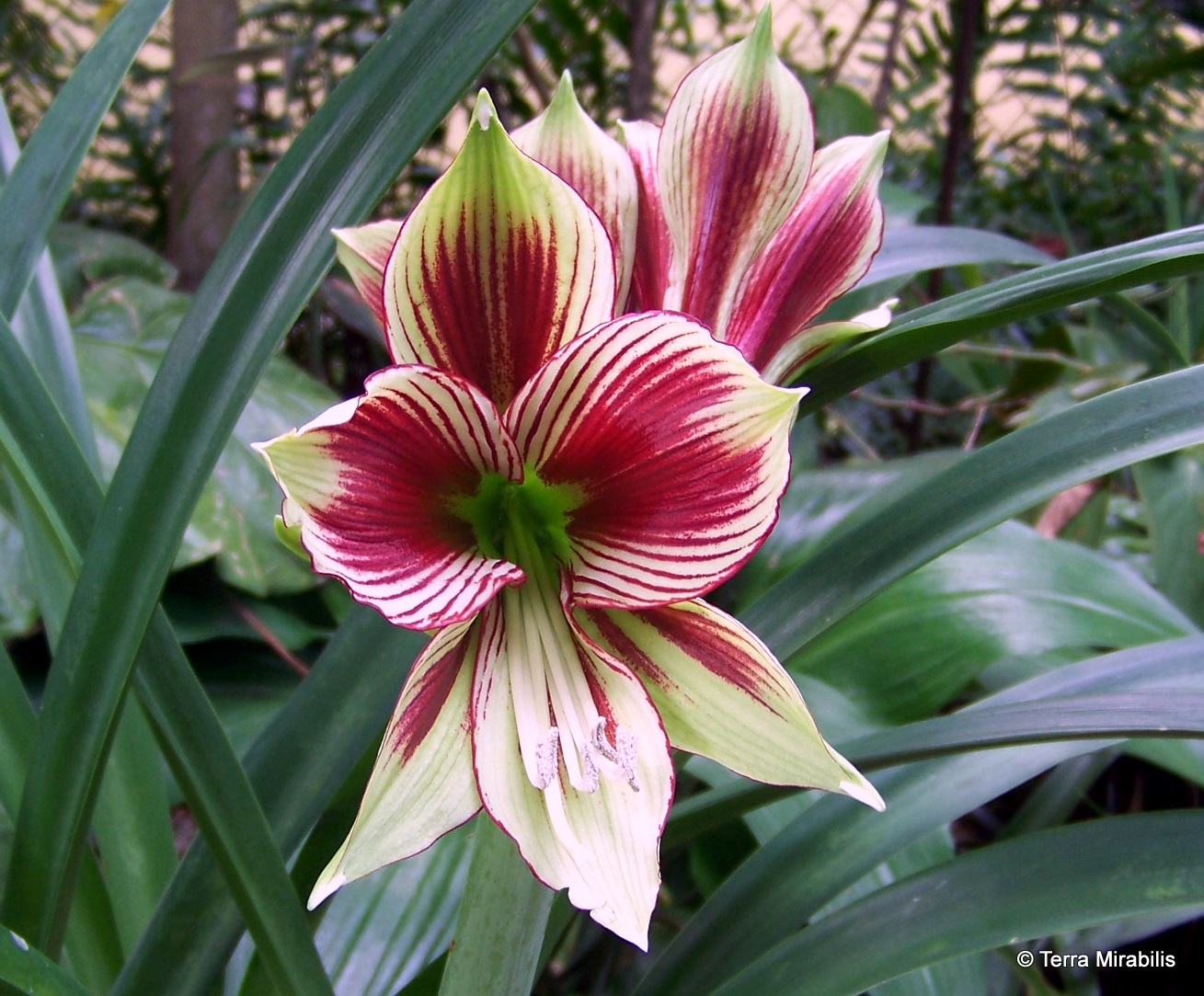
The butterfly amaryllis

Here's a plant you don't see often. I was fortunate enough to buy a large crowded pot of them from a former Fairchild Garden curator who was moving to Michigan.

The butterfly amaryllis, Hippeastrum papilio, is not technically an amaryllis since it's native to Brazil and all such South American bulbs are in the Hippeastrum genus; Amaryllis are native to Africa. But, as you probably realize, they are both are in the Amaryllidaceae family.

To my mind, these blooms are way more sophisticated than the gaudy Dutch amaryllis, as cheerful as they are. I love the lime green center and the maroon outline of the petals. The only drawback is that the flowers don't open as fully as commercial amaryllis.

I'm still figuring out the best light for them, but they seem to be happy in either bright sunlight or dappled shade. And they didn't mind the cold snap, either.


Sunday, February 20, 2011

The Great Backyard Bird Count

A blue-gray gnatcatcher
The 2011 Great Backyard Bird Count is taking place this weekend, and everyone in North America is invited to participate, even if it's only for 15 minutes. All you need is pen and paper, and you've got today and tomorrow's holiday to participate.

For me, of course, it's just another excuse to be outside on this glorious day. But instead of gardening tools I've got binoculars, camera and bird books .

I logged 12 species in the hour from 11:30 to 12:30, although I suspect if I'd started in the early morning, I would have seen more. Maybe I'll get up early tomorrow. Maybe ...

Tuesday, February 15, 2011

Oak and mango blossom


This morning, I was standing under one of the oak trees and realized there was a familiar humming above my head. For a moment, I thought the bees must have swarmed, but they were just collecting pollen from the extraordinary abundance of flowers the oaks have produced for the second year in a row. I'm sure it's the shock of a sharp cold spell that encourages them flower so prolifically.

And for a third year running, the mango trees are covered in blossom; again, I'm sure, because of the cold weather. (Who knew mango trees like a shot of cold?) We should have another bumper crop in a few months. If you don't live in the right climate to grow mangoes, consider moving!


Sunday, February 6, 2011

A sweet deal: honey for land

The starter beehives. The smoker calms them down.
Last fall we talked to a beekeeper about installing a hive or two on our smallish suburban property. Steve, the beeman, surprised us by saying there was room for four, and he shocked us by saying that we should get about five gallons of honey a year in exchange for "renting" the land for his hives. I mean, we love honey, but five gallons seems an awful lot. But, of course, it does solve the Christmas present dilemma...

So, in December, Steve brought four "starter" hives and made sure that there was enough sugar water for the bees during cold weather. Now, we've moved on to the full sized hives, and he says the first "supers" will be going on soon.

Steve, the beekeeper, inspects a frame from a hive and ...
I asked him about the problem of Africanized queens, and he said that he changes out the queens once a year so it won't be a problem. And since I've been weeding close by, I've learned that bees really don't bother me if I don't bother them.


Steve has some 600 hives, mostly in agricultural areas, and they have to be moved to wherever the blossoms need pollinating, but he really likes urban/suburban hives because they don't need moving and because there's always plenty of stuff in bloom. He already had hives in a friend's large backyard, which is why I called him, but your local extension office probably has a list of licensed beekeepers. Or, if you're in Florida, check FloridaBeekeepers.org or the Dept. of Ag.'s website.

Hosting beehives  is such a friendly thing to do, and I would encourage you to investigate for yourselves.


... points out the queen. Click for a better view; she's immediately to right of the colon.


Sparky and Highway investigate.

Sparky discovers that bees are tasty, but there is a drawback... It took several stings before he got the message! Highway, the chow, lost interest after the first inspection, but I think his fur is too thick for a bee to sting him, anyway.


Finally, the full size hives arrive. From now on they will grow upwards as our busy bees make lots of honey. :-)

Monday, January 17, 2011

Belated Happy New Year!

I'm embarrassed about how long it's been since I posted. Oh, well, life happens.

Since it's still the beginning of the year, I wanted to post something in honor of Janus, and what could be better than garden gates? On my walks and bike rides around the neighborhood, I've been struck by what gates tell us about the occupants.

My first thought? Drug dealers! Yikes! I wouldn't want to meet the people who live here.


Doesn't this make you feel welcome?

This is one of our gates...

... which, I think, entices you in, in large part because of the way the bricks are laid
I so want to know what's behind this gate

If you want to keep people out with a steel crate, at least this does it with a bit of charm
Here's a detail
This is attached to an ordinary South Florida ranch house and it really shouldn't work, yet, it clearly does


I think these occupants might be fun to get to know. The side gate has a moon and directly behind it, on the wall, is a smiling sun

Thursday, December 2, 2010

Worm tea and orchids

The worm bin in the photo is the second I've had, having first started with a simple plastic container. I like this stacking one better because it allows the liquid to collect and be drained easily. And, as any worm compostor knows, the liquid is the best fertilizer you can find.

Worm tea can be heavily diluted, and used as a drench or a spray, but I like to add about half again of water. Since the beginning of the year, I've used it exclusively on the orchids, with some very gratifying results.

I don't feed my orchids as often as I should, but most of them flower on and off regardless. However, for years I've had a large cattleya growing on the north side of a coconut palm trunk. It flowered once, nearly 10 years ago, but now it's got two huge blooms! I was stunned to find them a few days ago.

And a vandaceous orchid that's not flowered before produced some delightful blooms of the palest purple, a color I've not seen before.

Here are the pix:


An indication of the size

Thursday, November 11, 2010

Random pictures

It's been ages since I posted. I had computer problems and after they were fixed, I couldn't decide what to write about, what a friend back in England used to call a "rictus of indecision." While I sort out my rictus, I'll post some pix, with comments.

First, a couple of disasters:

This is my wonderful Souv. de la Maison that I heaped praise upon in my last post. I woke up one morning to find it completely wilted. I figured out that a certain dog had attempted to catch a squirrel or rat that must have run across the string of garden lights immediately above the pot and pretty much flattened the rose. There was an indentation of a paw print that gave the game away. Still, I think it will live to see another day. (Why do I still love my dogs?!)


The sky blue cluster vine, Jacquemontia pentanthos, is an endangered native, but can be found in a few nurseries. Two days after planting, it turned brown. Rats! With its little bright, bright blue flowers, it's such a pretty vine in the morning glory family. Click here for a close up of the flowers. I'm hoping that it isn't entirely dead, not least because it was an expensive plant and the nursery is 30 miles away.

But onto happier things:


This is a very old vanda that belonged to my husband's late aunt. She died in 1986 and she'd grown it for many years prior to that. It has a lovely old-fashioned look to it, and must have wowed orchid enthusiasts back in the day. I'm so glad I'm able to keep it going.


How do you tell if bananas are ripe? These only look yellow in the late afternoon sun, and they haven't done much for a couple of months except get a bit fatter. What gives? Tips and explanations are welcome.


I found these lovely Neoregelias, above, at a garage sale, while ...


... somebody threw these gorgeous broms onto a trash pile. I'm always happy to adopt unwanted specimens.


The second raised veggie bed, at the rear, has been built. Thanks, Dan!


The garden cherub is still standing, although his head frequently rolls off; they were parted when I found them at an estate sale. However, the dogs (grrrr) are responsible for breaking the lute, which I keep promising myself I will glue back on. It's only been two years ...


A clump of Philippine violets, Barleria cristata, is flowering prolifically by the bridge.


The pink Jatropha flowers all year round. But, best of all ...


... my Natchitoches noisette is about to produce a million blooms.

And hasn't the weather been lovely?

Monday, October 4, 2010

In praise of roses

Souv. de la Malmaison

There are orchid people, and there are rose people. Despite having dozens of orchids, I'm firmly in the latter category. Nothing speaks to my heart like a rose.

Our garden in England was full of roses, mostly hybrid teas, and we had a gardener take care of them, a luxury I certainly can't afford. Oh, but I loved growing up with vases of sweet scented blooms around the house.

Natchitoches noisette


Moving here in '86, I was happily surprised to find that roses grow in tropical climates, too. In fact, we used to visit a nursery out on Krome Avenue, way west of the city, operated by a lovely man who had grown roses in his native Cuba. You could even buy bunches of roses, and you'd never know what you'd get as he or his wife wandered around selecting the best blooms. That was part of the charm. Tragically, he was murdered when he was depositing cash at a night safe, and his wife didn't have the heart to keep the nursery going.

Natchitoches noisette

For a while, I grew hybrid teas, but I gave up because they're a lot of work and it takes masses of chemicals to keep blackspot, mildew and the like, at bay.

While roses can take all the heat and the sun on offer, they don't like humidity. Nor do they like the nematodes in our soil, so most roses are grown on nematode-resistant Fortuniana root stock. Since I grow my roses in pots, it doesn't matter to me.

Then, last winter, I ordered three old garden roses from Rose Petals Nursery in Gainesville: Souvenir de la Malmaison, Natchitoches noisette, and Louis Philippe; I'd heard that all three did well in Florida humidity. After a rocky start, when I thought they were all going to die (and thanks to Meems at Hoe and Shovel for encouraging me to stick with them), I am simply thrilled!

This past summer has proven to have been one of the hottest and stickiest on record, and my roses have thrived! They're all in pots and I feed them rabbit pellets (because they're made from alfalfa), and worm tea.  I occasionally find leaves with blackspot, but that's the worst of it.

As soon as I can afford it, I'll be buying more OGRs.

A vintage oil painting I found on eBay

Friday, September 24, 2010

Monarch butterflies

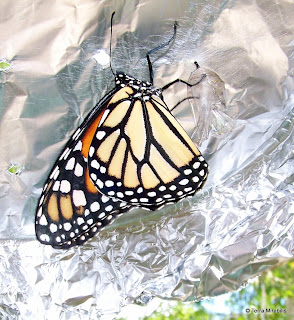
Click on the photo to see the empty chrysalis next to the hind feet

I don't have much luck with monarchs. Not because I don't have the right plants, and not because adult females don't lay eggs on those plants, but because damn great nonnative bufo toads (Bufo marinus) sit under them and feast on the growing caterpillars. So, when I found a solitary large caterpillar on a milkweed, with a toad waiting underneath, I took action.


I've never raised a butterfly in captivity before, and it turned out to be a successful endeavor. The caterpillar turned into a chrysalis two days later and about nine days after that, a beautiful, and good sized, monarch emerged. After being released, it spent a few hours flexing its wings before finally disappearing, and, ideally, getting ready to produce another generation.

The newly released monarch gathering strength
Nearly ready to fly away

Tuesday, September 21, 2010

I'm certified!

Hooray! The sign says it all. Note the gold label, which is the higher of the two classifications. (It's not difficult to qualify if you're an environmentally aware gardener.) 

The extension office in most Florida counties participates in the Florida Yards and Neighborhoods program.

My next goal is to have the garden certified as a Florida Backyard Wildlife Habitat, which is more complicated since there are forms to complete, a property survey -- with bird feeders, native trees, shrubs, and the like, all marked out -- to submit. Plus it will cost a whopping $5 for the sign.

Friday, September 17, 2010

Fall migration

Credit: Mark Jones, Painted Bunting Observation Team
Realizing that the migration must be well under way, and also being located under a major flyway, I Googled for information about what I could expect to see at my feeders.

I came across the website of the North Carolina based Painted Buntings Observer Team. It's latest blog entry, dated Aug. 31, said that the buntings had already been spotted in north Florida, which is quite a bit earlier than usual. (The redstarts appeared in my garden in August, which is also way earlier than usual; I wonder what they know that we don't?) Anyway, it means that painted buntings should be arriving in South Florida any day, if they're not already here. Time to make sure there's plenty of white millet in the feeders.

(For those who are not familiar with it, the painted bunting, Passerina ciris, is one of the continent's most colorful birds.)

I'd also read somewhere that migrating birds show up on radar, so I asked a friend, a meteorologist at the Miami National Weather Service office, if the NWS ever tracked migrations. His answer was no, however he did say:

"... the Doppler Radar imagery right around sunrise can give you an idea if there's an increase in bird population. There is usually a small ring or circle that expands outward in the area of the Everglades which occurs for about 10-20 minutes in the early morning. If you play a movie or loop of the base reflectivity radar imagery, you'll probably see it."
I got up too late this morning to catch it, but if you are an early bird, pardon the pun, please let me know if you see anything. Don't forget to hit the "refresh" button on the lower right.

Thursday, September 9, 2010

An unwelcome visitor, or the very hungry catarpillars

Credit: Wikipedia, Bugboy52.40
It's odd how attitudes will change. I spend a lot of time in the garden encouraging butterflies to visit and to lay eggs, but when an unwanted one arrives, I'm furious!

In this case, it's the oleander -- or polka dot -- moth (Syntomeida epilais) that's got my dander up. How dare it (they) lay eggs all over my Adeniums!

The harmless caterpillar looks a lot like that of the gulf fritillary, and the moth itself, which is actually rather beautiful, gets its name because, well, it likes oleanders. I no longer have oleanders, which are in the Apocynaceae family, along with Adeniums and my Mandevilla splendens that the caterpillars have also eaten back to the stems.

Since I do my best to stick to a no-kill policy, and because I do encourage wildlife to visit, this presents a dilemma, especially with at least eight much prized desert rose plants.

So, early in the week I went to a fabric shop and bought several yards of white nylon netting, the kind of material used for the underskirt of a wedding gown. The photo illustrates the first attempt of wrapping up a plant after picking off any caterpillars.

Fingers crossed this will do the trick. Stay tuned.