Wednesday, August 4, 2010

Passionvine virus warning; Pest Alert website

Collier County's Extension Office has just put out a warning about passionfruit crinkle potyvirus. The concern is that if it gets established, it will ultimately affect butterflies, such as the gulf fritillary and the zebra longwing, for which it's a host plant.

I learned about this today from Thomas Fasulo, who runs the very useful Featured Creature page on the University of Florida's IFAS website. He also maintains the Pest Alert listserv, which also provides invaluable info for Florida gardeners.

Saturday, July 31, 2010

Eastern lubber grasshopper

Adult Eastern Lubbers
In South Florida, you can find these critters all year round, with a peak in early summer. In most of its range (the rest of the Southeastern US) they are seasonal.

I was surprised to learn that despite their size (3" or 8 cm -ish), lubbers (Romalea microptera) cause less damage to crops and plants than smaller grasshoppers. In the home landscape, they're particularly fond of plants in the Amaryllidaceae family. I've seen them decimate crinum lilies used in public parks, for instance, as the smaller photo illustrates.

Lubber damage on a crinum lily
The best way to deal with them is to look for the young black-with-yellow nymphs, which like to cluster together, and dispose of them, because once they're large adults, they are much harder to find and kill, by then being resistant to most backyard insecticides.

If you need more info, check out the University of Florida's Featured Creature page.

Sunday, July 25, 2010

County's Adopt-a-Tree program is a blooming success

Crowds come and go at the tree give-away
This tree give-away program rocks! And kudos to Miami-Dade's Department of Environmental Resource Management for setting it up some 10-plus years ago. It's given away hundreds of thousands of shade trees -- flowering, fruit, natives -- to home owners who are entitled to up to two trees per year.

It started after a survey indicated that Dade's tree canopy was a horribly low 10 percent. And then the citrus canker fiasco began and some half million backyard citrus trees were cut down by the state in order to protect the commercial citrus industry. Fail.

So DERM applied for canopy restoration grants, and the rest is history.


After we complete the paperwork, we stand in line in the hot, hot sun, waiting our turn. (I've done this enough times to be prepared with hat and long sleeves.)


We watch the trees being unloaded from one of the huge tractor trailers, which collect the trees from local nurseries contracted to grow them for the county. (The program is a boon to nurseries, too.)


Finally! It's my turn. But I arrived late for today's event (one of four, this year). By the time I got to the head of the line, only pigeon plum (Coccoloba diversifolia) was left, which is way too big for my yard. I sneaked back around to the education center where, hooray, there were three native Dahoon holllies (Ilex cassine)  -- the trees I had wanted -- on display. Dahoon holly is dioecious and I managed to get the only female, showing small green berries. So, I came away a happy camper. I will claim another tree at the next event.


And here's my holly, home and waiting to go in the ground.

Sunday, July 18, 2010

Mangoes!

Eat your hearts out, northerners! It's mango season!

I skipped Fairchild Tropical Garden's mango festival last weekend because I knew I'd spend money I don't have. If you're planning on coming to South Florida sometime, think about timing it with the annual festival.

It's also proving to be another abundant year, and, as you see from the first pic, there are enough around so that  damaged or too small ones are simply discarded. Since my own mango tree is still too small to be allowed to develop fruit, I rootle around in these piles for ones that are still fine to eat. (Can you say mango smoothie?) I also go out on the bike and collect them from the public-rights-of-way where the trees overhang. (This whole neighborhood was once mango groves and many homes still have trees from the original groves.)

I took the other photos in the garden of fellow blogger TOG. He says his trees produce masses every year and the trick is to cut the trees back hard after the fruiting season. It also keeps the trees a very manageable size and enables several varieties in a small space. Trees that are allowed to get big eventually stop producing fruit and concentrate of getting even bigger.

Sunday, July 11, 2010

Old Miami

This is what much of South Florida, east of the Everglades, looked like until the post WWII building boom began the destruction. The "pine rocklands"
are unique to Miami-Dade County, parts of the Keys and a few Bahamian islands. Of the 225 species of native plants that grow on them in Dade, 20 percent can be found nowhere else, and their survival is far from guaranteed.

The understory palm, growing beneath the pines, is the low growing saw palmetto (Serenoa repens), used in several natural remedies, especially for prostate health.  It has nasty little spines along the petiole, hence the "saw" in the common name.


I bicycled over to this area with Sparky recently, but it's fenced off, which, while keeping people (and dogs) out, doesn't prevent invasive, non-native plants from taking root. Still, it didn't look too bad, so I guess the county is taking care of it. This particular site is only a few acres and, you guessed it, a new development is going up next door, although it seems to be stalled for the moment. (One of the few benefits of the recession?)


Many years ago, I was listening to Car Talk on National Public Radio, and someone from Pembroke Pines, a municipality in Broward County, just north of Miami-Dade, called in with a question. The Car Guys decided that pine trees couldn't possibly grow in a climate like this. Ha! Actually, these are a subspecies of  the southern slash pine, generally known as Dade County pine (Pinus elliottii var. densa).

They are very slow growing, which results in a dense, resin-filled wood that's resistant to termites. No wonder so much was cut down; every house built through the 50s had floors made of it. Fortunately, when old houses are being torn down, much of that precious wood is now being recycled.

The last photo is of a similar habitat, but this was taken in the National Key Deer Refuge on Big Pine Key. It gives the impression of being hot and dry, but this was a September afternoon, and it was hot and humid and the skeeters were out in full force.

Monday, July 5, 2010

A butterfly mystery

A few nights ago, around 10, I was surprised to find some half dozen zebra longwing butterflies (Heliconius charithonia) fluttering around an outside light. Butterflies to the flame! Does anyone know why they would do that?

Sunday, July 4, 2010

Rain lilies

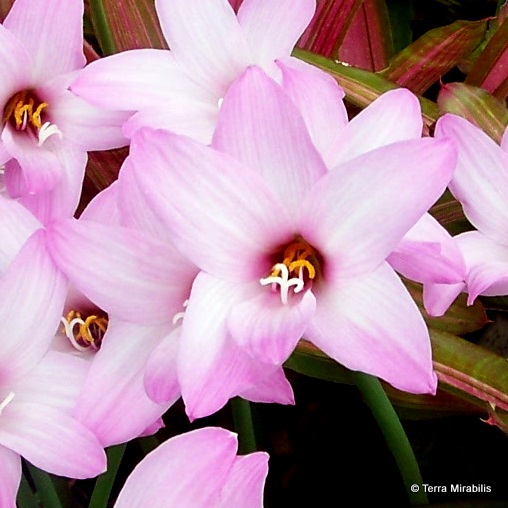
We must have had about 4 inches of rain last night, which thrilled the rain lilies, also known as zephyr lilies, (Habranthus robustus), because they rewarded us with one of the best displays in ages. The photos tell the story.

Thursday, July 1, 2010

June: Hottest month on record for S. Fla

In case anyone in South Florida didn't get the memo, it's been the hottest June on record. I can attest to that; I got prickly heat and the beginnings of heat exhaustion working in the yard this month. The latter is a first. Yikes!

The South Florida office of the National Weather Service also notes that Junes' record breaking heat -- averaging 85.5 degrees -- actually resulted in the hottest month ever! (Last August was the previous record at 85.4 degrees.)

No wonder my winter annuals gave up the ghost so much earlier than usual, as the photo of a miserable, sun-bleached trailing geranium indicates.

For those who want the gory details, you can read the NWS update here.

Lychees

I love this fruit with its flavor of damask roses or rose water. Native to tropical China, I once read that a Chinese empress sent her servants 1,500 miles to bring her some. 

After picking, the hard skin turns from rosy red to brown and peels like an eggshell. The white, translucent flesh (technically, the aril) surrounds an inedible, dark brown to black seed.

I'm assured that some varieties are better than others, but I don't know which they are. And I don't know which one I have; it'll be some years before it's big enough to fruit.

The trees in the photos are in the neighborhood and the fruit in the last pic was given to us by a friend.


Wednesday, June 23, 2010

Butterflies!

It was butterfly day in the garden a couple of days ago.

First, a pair of southern whites (Ascia monuste) obligingly settled in the perfect place for a photo. I don't know what it was they found so attractive, but they didn't want to leave it.

Not long after, a giant swallowtail (Papilio cresphontes) settled -- and stayed for a long time -- on a Murraya, close to where I was working.

If you're not familiar with this butterfly, it's not only the largest of the North American swallowtails, it's the largest butterfly on the continent, with a wingspan that may exceed six inches.
                                                                                                                                                                                                                       Realizing it was my lucky day for butterflies, I took the camera around the garden. After a fruitless wait for one of the skittish zebra longwings (Heliconius charithonia) to settle on something, a male julia (Dryas iulia -- note it's "i," not "j.") conveniently landed on an elephant ear right in front of me. This one is old (relatively speaking), probably a couple of weeks, indicated by the many missing scales.

Sunday, June 20, 2010

Missing the merry month of May, Part II


Click beetles.

Unlike the click beetles of temperate climates, where the larvae -- wire worms -- do so much damage to root crops, these beetles are beneficial. But the best thing is that they're bioluminescent.

Pyrophorus noctilucus is found throughout Central American, the Caribbean, and South Florida, it's northernmost range. It's not a firefly. (Fireflies are now rare in urban South Florida, although you can find plenty in the Everglades.) It prefers places of fairly dense vegetation to light up, although I also find them on the wall under an outside light -- as in my very poor photos.

Click beetles, which get their name from the loud "click" they make as they right themselves from an upside down position, have two neon-green luminous "eyes" on their backs, or, technically, the pronotum. In May, you find them glowing under vegetation. When they fly, though, they expose another glowing spot on the abdomen that glows steadily in flight; unlike their distant firefly cousins, they don't "flash."

Before the hurricanes of 2005 destroyed my hammock, I used to lie out in the evening and watch them glide past; it was such a treat. This past May was horrendously hot and humid, and the skies were filled with too many skeeters to make it any fun.

I found some much better photos on this site.

And if you're looking for an excuse to come here, make it to see these unique beetles in the merry month of May!

Missing the merry month of May, Part I

It's in May that the gardenia bushes burst into bloom and the air smells divine. I'm always amazed by how well these usually chlorotic shrubs do in our limestone soil. Traditionally, to keep them happy, one pours pickle juice and other acidic food waste around the roots. The simplest thing to do, really, is mulch them well.

Still, I keep my gardenias in large pots and water them from the rain barrel to avoid the problem. Even so, I've lost them from other diseases over the years. They tend to be a bit finicky in their needs.

My favorite bloomed throughout the winter, and wasn't even phased by the freeze. Extraordinary!

I also have a trailing gardenia. It's more of a curiosity since it's a very slow grower and the small flowers don't have a particularly strong scent. It's nice in a big ceramic pot and helps disguise the rain barrel.

Saturday, June 19, 2010

Gardening and the sunshine vitamin

Following routine blood work, I was surprised to learn from the doc that I had low Vitamin D levels. Apparently, it's so common that these days it's regularly tested for. Nobody knows why this should be so, but the doc said the odds-on favorite is excessive use of sunscreen. (The skin cancer message seems to have been received.) The pharmacist said the same thing when I picked up the D3 prescription.

Well, I'm not buying it. The best source of Vitamin D comes from sun exposure, and nobody, especially in these latitudes where the sun's rays are strongest, should be deficient. And especially if they spend time outside. I only use sunscreen when I plan to be in the garden for any length of time, but I'm not fanatical and I spend a few minutes here and there most days in sunlight. I have (light) tan lines to prove it.

There are all sorts of factors that govern the manufacture of D in the skin, including intensity of the rays and the color of the skin (the darker, the more sun exposure required). Here, for example, is what WebMD says:

Many people living in the Southern United States can get enough vitamin D by getting about 10-15 minutes of sun exposure on their arms and face a few times a week -- as long as they don't use sunscreen, which blocks some of the UV rays necessary to make the vitamin.

That is not difficult to do in South Florida.

So, dear readers, are you Vitamin D deficient? Do you think the sunscreen explanation is credible? Do weigh in.

Wednesday, June 16, 2010

Growing nasturtiums with the GROW Project, May report

Yet another late report ... Did I ever mention I have ADHD? (I do. Really.)

My Spitfire nasturtiums, an  exclusive from seed suppliers Renee's Garden, began struggling in May. We had record breaking heat, not to mention horrible humidity, and that took a toll on most of the annuals. I'm not sure whether the Spitfires will even make it into July. The GROW project sent them out in March, which is really too late for this climate; ideally, I would have planted in October or November.

The photos illustrate that these sweet little plants are not really thriving.

Tuesday, June 1, 2010

Royal poincianas

There are so many spectacular flowering trees, but the royal poinciana (Delonix regia) must be at the top for sheer extravaganza.

The first photo is of the tree on the other side of the road. It's not the typical shape, which is umbrella-like. The second photo, taken one block away, is more like it. You can also see two more further down, and in May and June, this is a common sight -- a tunnel of vermilion.

Poincianas (also known as flamboyants or flame trees) are true tropicals and I'm not sure how far north it grows, but probably not above Lake Okeechobee.

The first time I ever saw one I was visiting Guiana with my father. As I stood gobsmacked by the glorious sight, my poor old dad couldn't understand what I was talking about. Turns out that poincianas are all brown if you have red/green color blindness. Sadly, I also have the gene since I passed it on to my son. He can't appreciate them, either.